FFWD
- AI automation transforms workflows at massive scale—Atlassian’s Rovo alone has powered 2.4+ million new workflows—amplifying both efficiency and risk.
- Automation doesn’t eliminate risk; it changes the risk profile, increasing the blast radius of errors that can scale instantly across teams and systems.
- Common AI automation failures include cascading changes, error drift, and overreach—often invisible until widespread damage occurs.
- Large enterprises use 125–200 SaaS applications, expanding collaboration but also increasing exposure to data loss under the shared responsibility model.
- SaaS vendors restore platform functionality after an incident, but businesses remain responsible for restoring their own data at a granular level.
- Independent, granular backups are essential to manage AI automation risk, enable fast recovery, and maintain control, auditability, and resilience at scale.
Machine learning and advanced automation have already changed the workplace, literally and figuratively, transforming both what a workplace looks like and how it functions. Whether a home office or a hoteling office environment, the workplace is now suffused with automated processes.
Some automations, like face-to-face meetings with interregional or international partners at the click of a button, are visible and highly present. Many others happen invisibly in the background of your day-to-day processes. AI and advanced automation underlie workflows in every industry.
Consider one example. Thus far, Atlassian’s Rovo has powered more than 2.4 million new workflows to date, transforming the way countless businesses, departments, and teams work. At that scale, millions upon millions of data changes are now happening automatically, without human intervention or review.
This poses a brand-new level of risk.
AI automation and risk
There’s a common assumption that automation in the workplace reduces risk. After all, human error is one of the leading causes of data loss. But the truth, as always, is more nuanced. Rather than eliminating risk, automation changes your risk profile.
We know that automation can speed up workflow to an extraordinary degree. Unfortunately, when changes happen fast and on a large scale, the blast radius of any single mistake balloons instantly, affecting teams and processes that might otherwise have gone untouched. Damage rushes outwards, less like ripples in a pond and more like rogue waves crashing into surprised beach towns.
One small automation error can lead to large recovery and cleanup efforts, diverting time and resources away from business development. The negative effects don’t stop there: A major automation error can cause a serious dent in employee trust. And that doesn’t even touch consumer confidence, which is already fragile.
In this way, automation increases data risk. Reliable, granular backup is a necessary risk management tool.
Examples of AI automation risk
AI and automation-enhanced workflows reduce operational friction by performing rote tasks in the background without human input. The potential time saved is significant, freeing workers for more complex, creative, and demanding efforts. The thing is, taking out human input also reduces human checkpoints, leading to a lack of necessary oversight.
AI works within pre-defined parameters. It depends on rules, and there is no single rule that will work perfectly for every case. In fact, there’s no single rule that will fit every department: the finance department needs different things from AI than the sales department. Each group has its own compliance and sensitivity protocols. Getting them wrong can be operationally and reputationally disastrous.
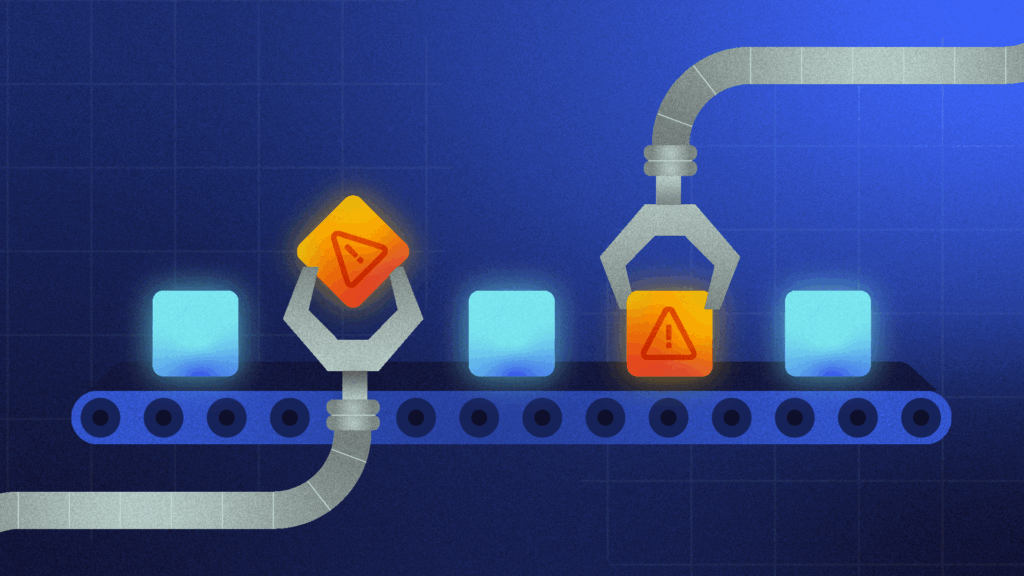
The most common automation failures are systemic. Unfortunately, they’re also often invisible until they have already happened. Once they start, they scale incredibly fast.
Misfired rules is a general term to describe AI failing to follow established rules and/or protocols in a way that causes errors or problems. A misfired rule can look like:.
- Cascading changes: when interconnected automated systems fail in tandem because of a single error in one. If a key sensor mistakenly reports the wrong temperature in a food processing plant, it could cause routing agents to needlessly avoid the area, causing unnecessary logistical traffic jams and delays.
- Technical fix: Broaden your simulation training. Run it in ‘at risk’ situations, coordinating with systems both up and downstream.
- Error drift: when automated systems rapidly share false, misleading, or outdated information. Consider the aggravation of an in-house AI that surfaces the vacation-booking policy from five years ago instead of this year.
- Technical fix: Ensure new or refreshed data is properly saved and stored to surface at need. Examine any permission errors and install stringent verification processes and quality control systems.
- Overreach: when AI exceeds the expected limits of its portfolio. For instance, a scheduler that cancels previously set meetings to make room for other meetings, without checking first for authorization to do so.
- Technical fix: Tighten the constraints of your rules, policy enforcement, and reward functions. For sensitive tasks, set permissions to ‘propose’ rather than ‘execute’.
SaaS and backups
For large companies, one major benefit of automation has been the rise of SaaS. No longer does each individual enterprise have to create and host its own proprietary operational systems; instead, it can partake of systems created and hosted by online platforms. POS, CSR, accounting, sales and marketing: no matter what your company does, you can integrate a platform that will give you full functionality without the concomitant hosting costs.
Today, large companies use between 125-200 SaaS applications each. These applications demolish silos, promote cross-team collaboration, and ensure everyone is working from the same single source of truth. However, these applications and platforms also introduce another element of risk: data loss.
While SaaS platforms provide the tools businesses need most in order to operate, they are also upfront about what they can and cannot do. After a major data loss event, a SaaS company can rebuild the functionality of its platform as a whole, but that’s where its responsibility ends. While they do save all your data, they combine it with all the data created by everyone who uses the platform in an aggregate form. That is not particularly helpful for you.
What shared responsibility actually means
The shared responsibility model means the SaaS provider is responsible for the availability, security, and performance of the platform infrastructure. This includes servers, networking, uptime, and system-level resilience.
You, however, are responsible for the integrity, protection, and recoverability of the data created within that platform. That includes accidental deletions, automation errors, misconfigurations, malicious insiders, and corrupted records.
If data is modified or deleted through valid credentials or automated workflows, the SaaS provider typically considers that authorized activity, not a platform failure. Restoring that data at a granular level is your responsibility.
Shared responsibility does not mean shared backups. It means shared risk, with clearly divided operational duties.
Consider a Jira environment connected to AI-powered automation. A misconfigured rule could bulk-transition thousands of issues, overwrite custom fields, or change project permissions in minutes. From Atlassian’s perspective, those changes were executed with valid credentials and therefore considered authorized activity. But for your team, untangling which fields changed, when, and how becomes a time-sensitive operational risk.
In Confluence, an automated permission update or bulk content edit could instantly restrict access to critical documentation or overwrite important pages. Again, the platform remains fully functional. The data, however, may be altered or lost at a granular level.
This is where independent backup becomes essential. A purpose-built solution such as Rewind for Jira or Rewind for Confluence allows you to restore specific issues, fields, projects, or pages without rolling back your entire environment.
The key to avoiding data loss
With widespread automation, risk management must become part of your daily operations. A comprehensive, flexible AI governance strategy must be the foundation of the adoption of any new automated or agentic functions. Rushing to adopt without thorough governance can lead to situations that, while unintentional, are expensive and time-consuming to fix.
The guardrails you build into your governance strategy, such as accountability and auditability frameworks with clearly established oversight, will help you anticipate and proactively respond to the risks introduced by AI. After all, the faster your business moves, the stronger your recovery strategy must be. A strong backup and recovery plan is one of those essential guardrails.
Regular backups provide security, resilience, and most importantly, control: over where your data is located, who has access to it, and how fast you can bounce back from any error or interruption.
Backups are a control mechanism for accountability, security and speed, not a sign of mistrust in your SaaS platforms. Thorough backups ensure your data is up to date, so your AI has the most recent and corrected versions to work with. Think of backups as memory hygiene: regular and routine to ensure the health and resilience of your business.
Data backups reduce the risk
New technologies provide a competitive advantage and simultaneously introduce new vulnerabilities. Even though its footprint might seem small, or its functions operate invisibly in the background, automation is, in fact, a large-scale workplace transformation. It needs to be thought of as such, with all the strategy and governance such change requires.
Introducing automation makes independent backup more critical, not less.
Ask yourself the following about your backup and recovery plan:
- Is it designed to handle automated changes at an ever-increasing scale?
- Do we have mechanisms in place for fast recovery of lost data at the granular level?
- Have we ensured that we have visibility into and control of our data in both the short and long term?
Protect every automated workflow
Schedule a recovery readiness review with one of our experts and close your backup gaps now.
 Rewind">