Every year on March 31, World Backup Day serves as an industry-wide reminder to protect your data. But in 2026, the conversation needs to go beyond simply having a backup in place. The real question is: if disaster struck right now, could you actually recover?
For most organizations, the answer is unsettling. According to recent industry research, only 14% of IT leaders are confident they could recover critical SaaS data within minutes. Meanwhile, 70% of businesses using SaaS applications have experienced data loss from those platforms, and nearly three-quarters lack offsite data protection entirely.
This World Backup Day, it is time to move past the annual reminder and confront a harder truth: backup is table stakes. Data resilience is the standard your business actually needs to meet.
The SaaS shared responsibility gap
One of the most persistent and costly misconceptions in cloud computing is the belief that your SaaS provider is responsible for backing up and recovering your data. Research shows that 43% of organizations either believe the SaaS vendor handles backup or are unsure where that responsibility falls.
The reality is starkly different. Platforms like Salesforce, Atlassian, Shopify, and Microsoft 365 operate under a shared responsibility model. The provider is responsible for infrastructure availability, keeping the platform running and accessible. But the data you create, configure, and store within those platforms? That is your responsibility to protect.
Most SaaS terms of service include explicit disclaimers about data loss. If an employee accidentally deletes critical records, if a third-party integration corrupts your data, or if a bad migration wipes out months of work, the platform provider is under no obligation to recover it for you. The shared responsibility model means that your SaaS data backup strategy cannot rely on your vendor — it must be independently managed.
The 2026 threat landscape: Why urgency is growing
The need for robust SaaS data backup best practices has never been more pressing. The threat landscape in 2026 is defined by three accelerating risks:
- Ransomware is targeting backups directly. An estimated 93% of cyberattacks now target backup systems, with 68% successfully destroying critical data. Attackers understand that if they can eliminate your recovery capability, they maximize leverage.
- Cloud outages are increasingly common. 87% of enterprises reported at least one material cloud service disruption in the past 12 months. The median loss per major outage exceeded $1.3 million for mid-market companies.
- Regulatory pressure is intensifying. Regulations such as DORA, NIS2, and the Cyber Resilience Act now explicitly require organizations to maintain backup and recovery documentation, test recovery procedures, and demonstrate compliance, with fines reaching up to 2% of annual revenue for non-compliance.
These are not hypothetical risks. More than 60% of enterprises experienced at least one major data loss incident in the past year, with average recovery costs exceeding $4 million per event. For small and mid-sized businesses, the stakes are existential: over 60% of SMBs that suffer severe data loss shut down within six months.
From backup to data resilience
Having a backup is necessary but insufficient. A data resilience strategy goes further, encompassing not only the ability to store copies of your data but to recover it quickly, verify its integrity, and meet compliance requirements under pressure.
The classic 3-2-1 backup rule — three copies of your data, on two different media types, with one offsite — remains a sound foundation. But for SaaS environments, it needs updating. Consider the 3-2-1 rule for the cloud:
- Three copies of your data (production + two backups)
- Two independent cloud locations (not both inside the same SaaS provider’s ecosystem)
- One backup managed by a dedicated third-party solution — not your SaaS vendor
True data resilience also means defining and testing your Recovery Time Objectives (RTO) and Recovery Point Objectives (RPO). How much data can you afford to lose? How quickly do you need to be operational again? If you cannot answer those questions with specifics, your backup strategy has a gap.
Test your defences
Understanding your risk is one thing. Experiencing it is another.







If you are on a desktop, please use the left and right arrow keys to fly the boomerang. To shoot down the SaaS invaders, use the space bar to fire your backup lazer.
For mobile users, use the buttons below.
 Left Button
 (Mobile)
 Right Button
 (Mobile)
 Shoot Button
 (Mobile)

A legion of SaaS invaders is attempting to compromise or delete your data. But before they can do this, they must first have access to your cloud. Your mission is to prevent the cloud from being taken.
You must destroy each group of invaders and not let a single one enter the cloud, or your SaaS data will be lost forever.

Disgruntled Employee
rogue & deleting files.

Cyberattacks & Malware
cybercriminals want your data.

Human Error
Although mistakes happen, they can be costly.

Software bugs
Buggy third-party SaaS app integrations.
This is a remake of Space Invaders.
Made by Jay Hwang
Press space to shoot, and use arrows to move.
Collect drops from mystery UFOs!


Copied results to clipboard
Click to restart




We built Cover Your SaaS to bring the stakes of data protection to life. In this browser-based game, you defend your business-critical SaaS data against cyber threats, corrupted files, and rogue integrations — Space Invaders style. It is a quick, interactive way to think about the threats your data faces every day and why automated backup and recovery matters.
Play the game below, then challenge your team. Post your high score on LinkedIn and see how your colleagues stack up.
Building your SaaS resilience strategy
Whether you are evaluating your current approach or starting from scratch, a strong SaaS backup and recovery strategy should address the following:
- Automated, daily backups across all critical SaaS applications — not just the ones your IT team remembers to configure.
- Granular recovery that lets you restore individual records, files, or configurations — not just full-environment snapshots.
- Defined RTO and RPO targets that are documented, communicated to stakeholders, and tested at least quarterly.
- Compliance-ready audit trails that satisfy ISO 27001, SOC 2, GDPR, HIPAA, DORA, and other regulatory frameworks your business must meet.
- Independent storage that is not controlled by or dependent on the SaaS vendor whose data you are backing up.
The goal is not to add another tool to your stack for its own sake. It is to close the gap between having a backup and having confidence that you can recover quickly, completely, and in compliance with the standards your business is held to.
Start protecting your SaaS data today
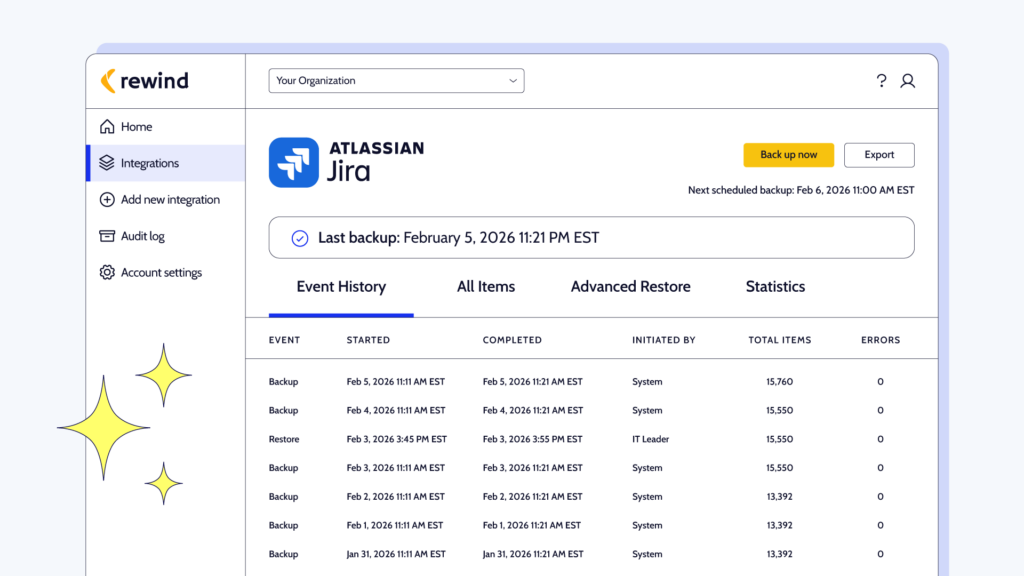
World Backup Day 2026 is the perfect opportunity to move from awareness to action. Rewind provides automated backup and recovery for leading SaaS platforms, including Jira, Confluence, GitHub, Shopify, BigCommerce, QuickBooks Online, and more — all from a single dashboard.
Start your free trial today and find out what real data resilience looks like.
─────────────────────────────────────
Sources & Citations
· DataStackHub, “Data Loss Statistics 2025-2026”
· HYCU, “State of SaaS Resilience Report 2025”
· CrashPlan, “75+ Data Loss Statistics for 2026”
· Barracuda, “World Backup Day Turns 14” (2025)
· DataStackHub, “Cloud Outage Statistics 2025-2026”
· Own, “State of SaaS Data Protection Report”
· Kalp Systems, “Cloud Security 2026: Shared Responsibility”
· IBM, “Cost of a Data Breach Report 2025”
 Rewind">